S2E1: The data & eh'I podcast
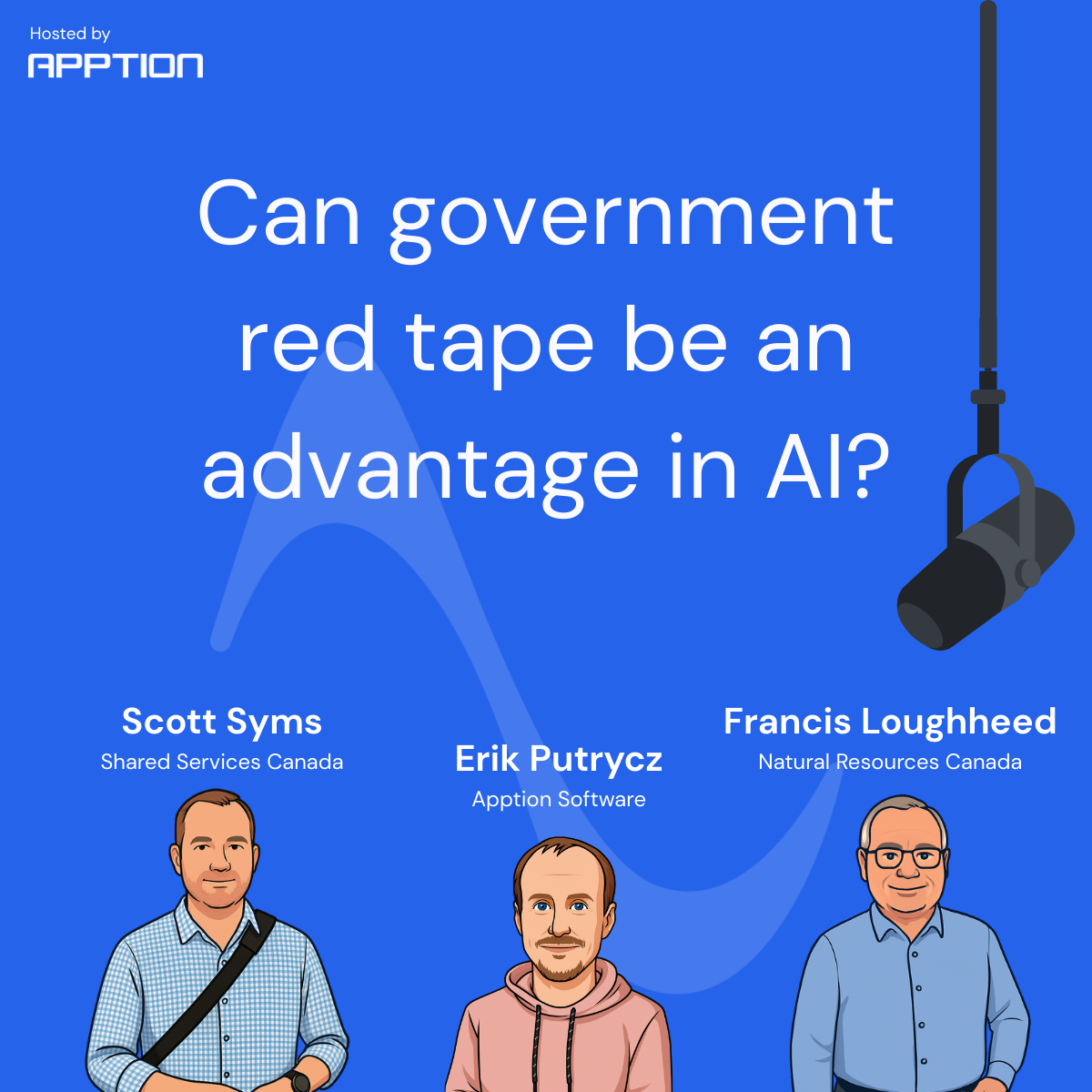
Join Apption's, Ara Coutts in a discussion with Canadian AI innovators Scott Syms of Shared Services Canada, Erik Putrycz of Apption and Francis Loughheed of Natural Ressources Canada in a candid discussion of how AI can be adopted in government.
We see this conversation from the perspective of AI and data advocates in federal government, Scott and Francis, as well from lead data scientist Erik who works on the other side of AI and data projects.
Don’t have time to listen to the full episode?
No problem! check out our episode run down ⬇
In this episode of The data and eh'I podcast, leaders from Shared Services Canada, Natural Resources Canada, and Apption tackle a big question in public sector innovation: can bureaucracy actually help accelerate the use of artificial intelligence?
Scott Syms from Shared Services Canada shares the story of CanChat, an internal AI assistant powered by a private language model built and hosted within government infrastructure. Scott's team deliberately chose an open-source path, allowing them to prototype quickly while keeping sensitive data secure. Scott notes,
“We just don’t want people willy-nilly pasting content into a chatbot. There needs to be some guidance, guide rails set around that.”
Francis Loughheed from Natural Resources Canada brings a different perspective, emphasizing the role of organizational culture in adoption. His work on data literacy and digital change management shows that technology only succeeds if people embrace it.
“Culture will eat strategy for breakfast every single day. How do we transform organizational culture to embrace data and digital assets and approaches?”
he asks, highlighting how NRCan uses data personas and grassroots champions to move AI from pilot projects to scalable solutions.
Erik, CTO of Apption, rounds out the conversation with insights from consulting across both government and private sector clients. While governments are often seen as slow, Erik argues they can move faster than expected when the right teams come together. Pilots launch quickly; the real challenge is scaling them to be sustainable.
Together, the panelists discuss how experimentation, collaboration across departments, and even “red tape” can provide the structure and safeguards needed for responsible innovation.
The panel closed with a surprising point of consensus: before any AI project can succeed, the real question isn’t about algorithms or models, it’s about data quality. When asked what question about AI more people should be asking, all three panelists agreed: “How good is our data?”
As Francis noted, most organizations assume their datasets are accurate and ready to deploy. In reality, he states:
"I have never seen a dataset that doesn't need a ton of work before it's ready for the use case!"
The overwhelming consensus among panelists was that companies think they have credible, accurate datasets. In reality, simply plugging messy data into a chatbot won’t produce the administrative relief many people expect. The conversation reinforced a central theme of the session: responsible innovation depends not just on experimentation and collaboration, but on building a strong foundation of trustworthy data.
Listeners will walk away with a clearer picture of how Canada’s public sector is navigating AI adoption while balancing speed with responsibility, pilots with scale, and technology with culture.
So, does bureaucracy accelerate AI adoption? You'll hear high-profile examples and some thought-provoking arguments, but you'll have to listen and decide for yourself!
If you like what you heard today, explore more Apption podcasts here